


Major CRM Trends in 2026: When AI Redefines the Customer Relationship
In 2026, CRM has become critical infrastructure, on a par with an ERP or a financial management system. Developers no longer just maintain fields or sales pipelines: they now have to architect intelligent ecosystems able to orchestrate data, automate workflows and put AI to work in production.
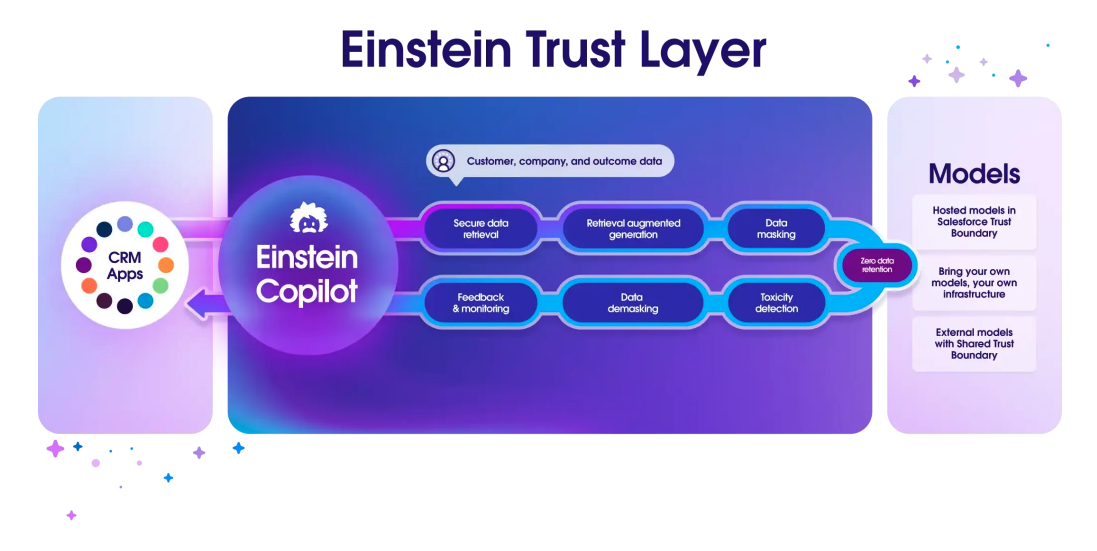
Salesforce: when Apex meets Einstein AI
At Salesforce, AI is now built into the core of the application runtime. With Einstein GPT and AI Cloud, it is possible to trigger:
- Apex triggers conditioned by predictions (e.g. automatic task creation if the closing probability exceeds a threshold).
- Platform Events enriched in real time by a scoring model.
- AI-powered Flows able to anticipate follow-up or alert actions.
This means Salesforce developers no longer work only on CRM objects but on hybrid pipelines where AI supplies real-time signals that trigger application code.
HubSpot: webhooks, CRM API v3 and predictive AI
As announced at the INBOUND 2025 event in San Francisco, HubSpot has made a clear shift toward AI with the development of Breeze and API-first architectures. With the CRM API v3, a developer can:
- Retrieve and enrich opportunities via /crm/v3/objects/deals.
- Plug in an external AI service via webhooks (e.g. deal creation) that enriches the deal with a calculated property (predicted_close_rate).
- Use dynamic associations (contact ↔ deal ↔ company) to train a predictive model and feed the result back into the CRM.
This event-driven model pushes developers to design microservices around HubSpot, often connected to specialized LLMs. As Raphaël Vuillier, managing director of StackEasy, a Bordeaux-based AI agency, points out: "The CRM becomes a source of truth augmented by intelligent agents, able to process data in context and enrich business decisions."

Microsoft Dynamics 365: Dataverse, plugins and Copilot
On the Dynamics side, the technical approach relies on Dataverse and the growing power of the built-in Copilot:
- Developers consume data through the OData API, ensuring a unified view.
- They trigger C# plugins or Azure Functions on every critical event (new Lead, Case creation).
- They inject AI insights directly into Dynamics forms via the Power Apps Component Framework (PCF).
Here, the challenge is to orchestrate a cloud-native flow, often coupled with Azure services, to automate enrichment and scoring in real time.
The new technical challenges
These changes place new responsibilities on CRM developers:
- Security and encryption: preventing external models from directly accessing sensitive data.
- Scalability: supporting thousands of simultaneous webhook or Platform Events without bottlenecks.
- Interoperability: maintaining open architectures that avoid vendor lock-in.
- AI explainability: understanding and auditing the recommendations generated by models.

Toward an era of augmented CRM
What is taking shape is an augmented CRM, where AI, APIs and microservices combine to form a coherent environment. Developers are becoming architects of intelligent integrations.
Laura Marchoux, director of the Script development agency, which specializes in building custom tools, sums up the challenge well: "Tomorrow's CRMs will not be defined by their native features, but by how technical teams manage to extend them and integrate them into the company's overall ecosystem."
Conclusion
Salesforce, HubSpot and Dynamics provide the necessary building blocks: APIs, webhooks, real-time events, built-in AI modules. But the difference lies in the technical implementation: how developers use these capabilities, structure data flows and integrate AI to create a truly proactive CRM.
It is in this articulation between advanced CRM engineering and intelligent agents that the new era of CRM is taking shape.
the most common questions
AI, advanced automation, real-time data, personalization and connected architectures are reshaping CRM platforms.
AI helps qualify leads, predict behavior, automate tasks and recommend relevant actions.
They improve responsiveness, productivity and decision-making across sales, marketing and service teams.
They need modern platforms, reliable integrations, strong data governance and carefully supervised AI use cases.